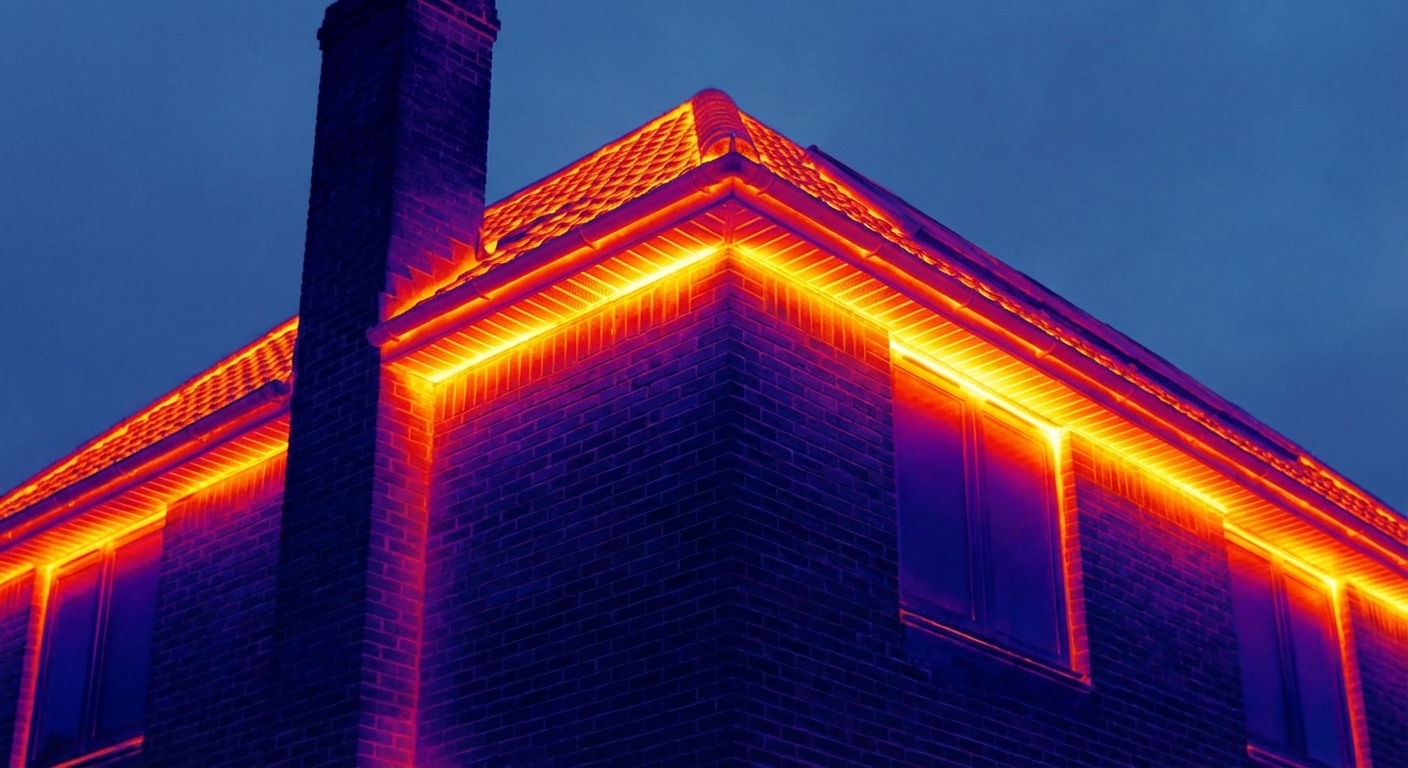
Commercial Flat Roof Thermal Moisture Scans in Houston: Pinpointing Leaks vs. Full Section 179 Roof Replacement
Replacing a 40,000-square-foot Houston TPO or modified-bitumen roof based on interior ceiling stains alone often wastes six figures in dry, serviceable insulation. Here is how post-sunset FLIR thermal capacitance imaging maps exact wet-deck boundaries—and how CFOs weigh targeted repairs against IRC Section 179 roof expensing in 2026.
- Water trapped inside polyiso or perlite roof insulation holds daytime Gulf Coast solar heat hours after sunset, glowing clearly on a 307,200-pixel FLIR T620 radiometric scan.
- Water can travel 30 to 90 feet laterally along steel deck flutes before dripping onto a tenant’s ceiling tile—visual roof walks miss the true saturation perimeter.
- When less than 15%–25% of insulation is saturated and seams remain pliable, surgical wet-core removal and membrane patching often extends roof life 7 to 10+ years.
- Under current tax rules, immediate repair write-offs (IRS tangible property regulations) and IRC Section 179 nonresidential roof expensing reward data-backed capital documentation.
Why Houston Low-Slope Commercial Roofs Fail Silently Long Before Ceiling Tiles Stain
Across Greater Houston—from tilt-wall distribution warehouses along Beltway 8 and I-10 to medical plazas in Memorial, strip centers on Westheimer, and Class B office buildings near the Energy Corridor—low-slope commercial roofs endure one of North America’s harshest hydrothermal cycles. Summer membrane surface temperatures routinely exceed 155°F before 4:00 PM Gulf Coast cloudbursts dump two inches of rain in thirty minutes, shock-cooling flashings, HVAC pitch pans, parapet copings, and thermoplastic polyolefin (TPO) seams.
Once water breaches a micro-split around a rooftop package unit or clogged scupper, it rarely drips straight down. Instead, moisture wicks laterally through polyisocyanurate or fiberglass rigid board insulation and rides corrugated metal deck flutes until it finds a screw penetration fifty feet away. By the time a retail tenant reports a brown ceiling stain, thousands of gallons of water may already be saturating structural insulation, corroding steel fasteners, and driving up air-conditioning tonnage loads. Commissioning comprehensive Houston commercial property inspections before signing a triple-net lease, refinancing, or approving a roofing bid replaces guesswork with hard radiometric proof.
Dry roof insulation has low thermal mass and cools rapidly after sundown. Saturated insulation stores 4 to 5 times more heat energy per cubic foot, creating unmistakable warm thermal anomalies during the post-sunset radiometric window.
Inside an ASTM-Aligned Post-Sunset FLIR T620 Roof Moisture Survey
Not all infrared cameras can resolve subtle ΔT (delta-T) moisture signatures across reflective white TPO or gravel-ballasted built-up roofs. Consumer-grade 80×60 or 160×120 thermal attachments blur seam-level anomalies from thirty feet away. At Able Inspections & Infrared Services—serving Houston since 1984 under TREC License #332—our Level II Infrared Thermographers deploy high-resolution FLIR T620 radiometric systems capturing 640×480 resolution (307,200 individual temperature measurement points per frame) paired with calibrated invasive capacitance/pin moisture verification.
Following ASTM C1153 methodology, we time roof scans for sunny, dry days with low evening wind speeds so solar loading charges the roof assembly evenly. Roughly 60 to 120 minutes after sunset, dry insulation radiates its stored heat to the night sky while water-logged cells remain measurably warmer. Through our specialized Houston infrared inspection services, we mark wet boundaries directly on the membrane (or map GPS/architectural grid zones), verify moisture Readings with a non-destructive impedance meter, and deliver side-by-side visual and radiometric thermograms your roofing contractor and insurance adjuster can act on immediately.
- Pre-acquisition due diligence: quantify hidden roof liabilities during your commercial inspection contingency so you can negotiate seller credits backed by thermal imagery.
- New-roof warranty closeouts: scan newly installed commercial membranes in Month 10 before the contractor’s 1- or 2-year workmanship warranty expires.
- Post-hurricane & hail documentation: isolate fresh storm-driven parapet and RTU curb intrusion from pre-existing wear after Gulf Coast named storms.
- Energy loss & R-value recovery: wet polyiso loses over 60% of its insulating R-value, forcing Houston rooftop chillers and DX units to run overtime all summer.
Surgical Wet-Core Repair vs. Silicone Coating vs. Full Tear-Off: The Engineering Matrix
Roofing contractors bidding without a thermal moisture map face a liability dilemma: if they quote a localized patch over unmapped wet board, trapped vapor will blister the new patch within months—so most default to quoting a complete tear-off at $9 to $16+ per square foot. A radiometric moisture survey gives building owners objective percentages to choose the highest-ROI path.
| Thermal Scan Finding | Saturated Area % | Recommended Engineering Action | Typical Cost Impact (40,000 sq ft) |
|---|---|---|---|
| Isolated RTU curb, scupper, or pipe-boot plumes | Under 8% of deck | Surgical wet-core cutout, new polyiso infill & heat-welded patch | $6,500 – $18,000 vs. $420,000+ unnecessary tear-off |
| Moderate seam fatigue, localized wet zones, sound deck | 8% – 22% of deck | Targeted wet insulation replacement + elastomeric/silicone restoration | Saves 45%–60% vs. full tear-off; avoids tenant business disruption |
| Widespread saturation, fastener back-out, brittle membrane | Over 25%–30% of deck | Full tear-off to structural deck, tapered polyiso & new 60–80 mil TPO/mod-bit | Full capital replacement ($380,000 – $600,000+) eligible for Section 179 evaluation |
2026 Tax Strategy: IRS Repair Regulations vs. IRC Section 179 Commercial Roof Expensing
Once your infrared inspection report establishes the exact physical scope of work, how that expenditure is structured on your tax return can swing first-year after-tax cash flow by tens of thousands of dollars. Historically, commercial building roofs had to be depreciated slowly over 39 years. Today, nonresidential real property owners have two powerful—yet distinct—tax frameworks to evaluate with their CPA depending on whether the thermal scan supports a localized repair or a full replacement.
First, under the IRS Tangible Property Regulations (the “BAR” test: Betterment, Adaptation, or Restoration), surgical leak remediation—such as cutting out 6% of saturated insulation identified by a FLIR scan and resealing flashings to keep an existing roof operating normally—often qualifies as an ordinary and necessary maintenance repair, deductible 100% in the current year without touching depreciation caps. Second, when thermal imaging proves widespread saturation requiring a full commercial roof replacement, Congress specifically added roofs, HVAC rooftop units, fire protection, and security systems on nonresidential buildings as eligible IRC Section 179 property—allowing qualifying active businesses to expense substantial commercial roof replacements immediately up to annual Section 179 dollar and taxable-income thresholds rather than waiting 39 years.
Because passive-investor rules, entity structure, and annual Section 179 phase-out limits require careful modeling before year-end contract execution, commercial owners frequently review real-estate depreciation breakdowns on the River Taxes commercial and small-business tax blog and run preliminary cash-flow numbers through interactive business tax planning calculators alongside their tax advisor.
How to Prepare Your Facility for a Commercial Infrared Roof & Electrical Scan
For maximum diagnostic value, most Houston asset managers pair an evening roof moisture survey with a daytime interior scan of main switchgear, 480V three-phase distribution panels, and rooftop HVAC disconnects—catching loose lugs and unbalanced phases on the same mobilization. Curious how high-performing inspection and facility firms coordinate urgent commercial dispatches without missing after-hours calls? Read our guide on why facility managers and realtors book the first inspector who answers. Investing in residential rentals or single-family acquisitions as well? Explore our Houston homebuyer infrared thermal & electrical safety checklist.
To schedule a commercial thermal moisture survey or full PCA-style property inspection anywhere in the Greater Houston metro, call Able Inspections at 713-465-0000 or request a proposal through our Houston inspector contact page.
Frequently Asked Questions
Can infrared thermography see through reflective white TPO or elastomeric roof coatings?
+
Yes, when performed during the post-sunset thermal capacitance window by a trained Level II thermographer. During daylight, solar glare on white TPO creates reflective artifacts, which is why commercial roof moisture scans are conducted after sundown once radiative cooling isolates subsurface water mass.
How dry must the weather be before a commercial flat roof infrared scan in Houston?
+
Ideally, the roof surface should be free of standing puddles with at least 24 hours since the last rainfall and 4+ hours of daytime sunshine to thermally charge the insulation assembly, followed by low wind speeds (<15 mph) after sunset.
Does an infrared roof scan damage or void an existing manufacturer roof warranty?
+
No. Radiometric FLIR thermal imaging and surface impedance testing are 100% non-destructive. No core cuts are required unless the building owner specifically authorizes a roofing technician to pull a physical verification core.
Does Section 179 apply to residential rental roofs or only nonresidential commercial buildings?
+
IRC Section 179 roof expensing specifically covers nonresidential real property (warehouses, offices, retail centers, industrial plants, medical buildings) placed in service after the building was first placed in service. Always confirm passive-activity and entity eligibility with your CPA.
Related Inspection Services
Commercial Property Inspections
Full structural, HVAC, electrical, plumbing, and envelope inspections for Houston offices, warehouses, and retail.
View Service →Infrared Inspection Services
High-resolution 307,200-pixel FLIR T620 thermal imaging by certified Level II thermographers.
View Service →Request Commercial Proposal
Speak with our TREC #332 Houston inspection team at 713-465-0000 for rapid turnaround.
View Service →More Houston Infrared & Property Guides
Why Real Estate Agents & Facility Managers Book the First Inspector Who Answers: 24/7 Voice AI Scheduling in 2026
When a Houston buyer’s offer is executed at 7:45 PM on a Friday with a five-day Texas option clock ticking, nobody waits until Monday morning for a voicemail callback. Here is why speed-to-answer defines modern inspection firms—and how 24/7 conversational Voice AI keeps senior inspectors focused in the field.
Read Full Guide →Residential Buyer Guide • 9 min readHouston Homebuyer's Infrared Thermal Checklist: Finding Hidden Moisture, Hot Breakers & Pet-Safe Electrical Hazards
Fresh staging paint and new baseboards can hide slow upstairs shower-pan leaks, missing attic insulation, and overheating electrical breakers from the naked eye—until move-in week. Use this room-by-room Houston infrared checklist to protect your investment, your family, and the curious pets exploring every baseboard.
Read Full Guide →Schedule Your FLIR Thermal Property Inspection Today
TREC License #332 • Certified Level II Infrared Thermographers • Residential & Commercial Coverage Across Greater Houston.